Growing businesses often accumulate tools faster than coherence. Learn how to determine whether you need another platform, better integration, or a clearer operating system.
Growing businesses rarely set out to build a fragmented technology environment.
They add technology one reasonable decision at a time.
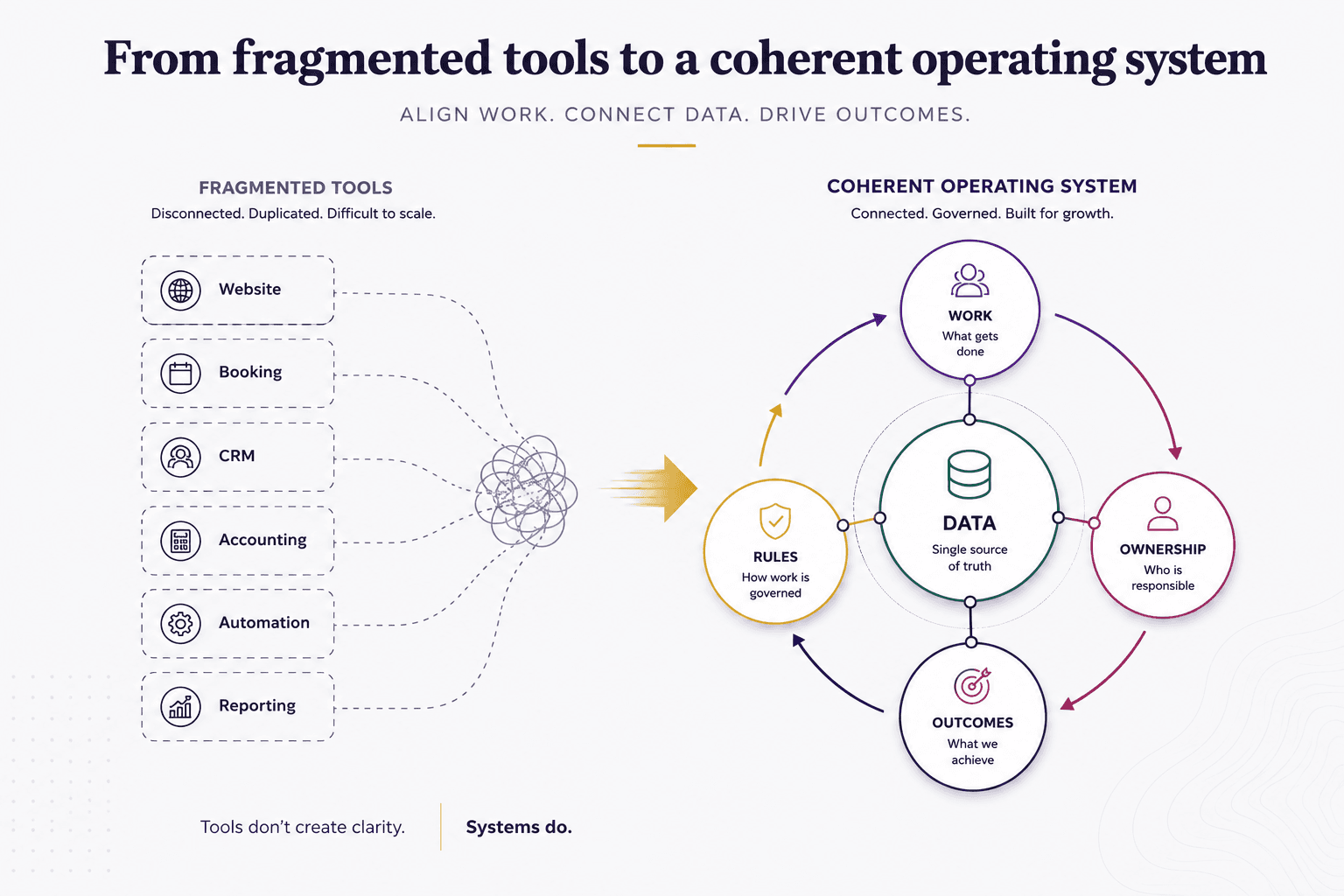
A website gives the business a digital presence. A booking system makes scheduling easier. A customer relationship management platform helps organize leads. An accounting application manages invoices. An automation tool reduces repetitive work. A dashboard promises better visibility. A vendor introduces another system to solve a problem the existing tools do not appear to handle.
Each decision may be justified on its own. The problem becomes visible later, in the spaces between them.
A customer submits a form, but someone still has to enter the information into another system. A booked prospect continues receiving messages meant for unqualified leads. Sales numbers, marketing activity, and service delivery data tell different stories. Employees create spreadsheets to reconcile what the platforms cannot. Leadership has more dashboards but no clearer view of what is actually happening.
At that point, the business may conclude that it needs better technology.
But that is not always the real problem.
The business may have enough tools. What it lacks is a coherent system.
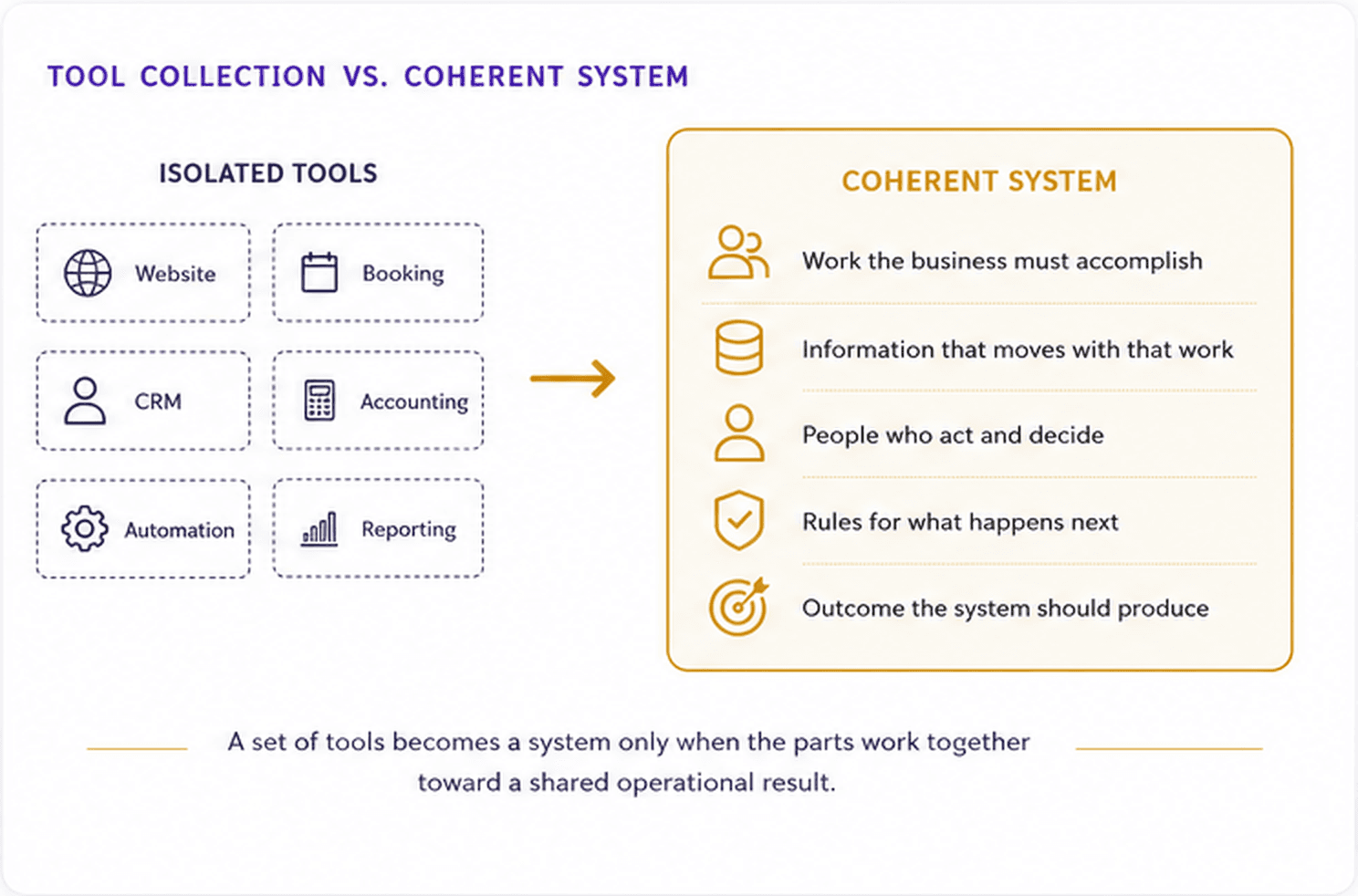
Tool collection vs. coherent system
Tool accumulation is not the same as system design
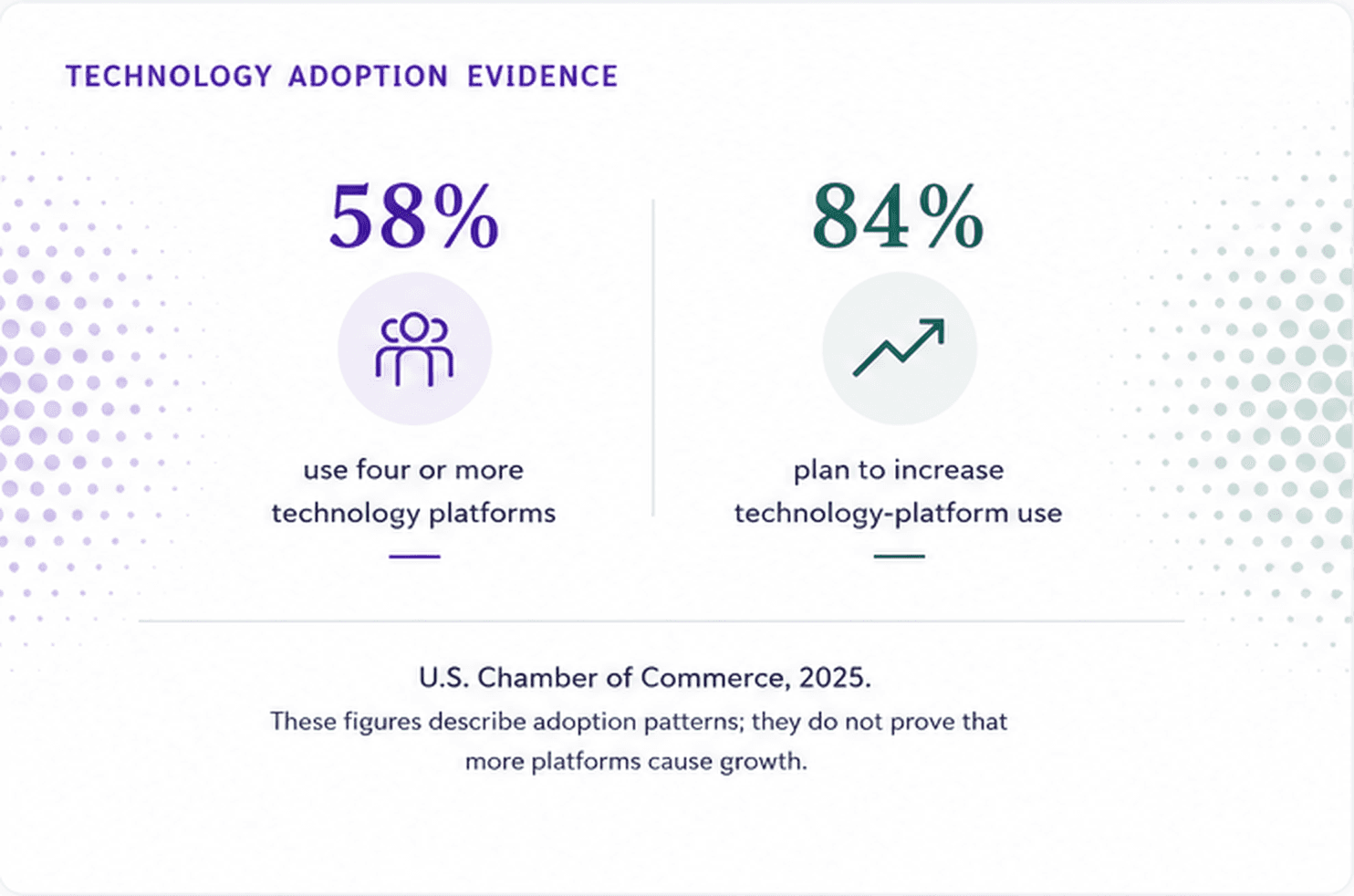
Technology adoption is not inherently the problem. It is part of how businesses grow. The U.S. Chamber of Commerce reported in 2025 that 99% of surveyed small businesses used at least one technology platform, 58% used four or more, and 84% planned to increase their use of technology. The same research found a positive correlation between effective technology use and business growth. The lesson is not that businesses should use fewer tools. It is that adding technology and gaining value from technology are two different things. (U.S. Chamber of Commerce, 2025 (opens in a new tab))
Technology adoption evidence
A collection of applications becomes a system only when the parts work together toward a shared operational result.
That requires more than integration in the technical sense. It requires alignment across five elements:
- the work the business is trying to accomplish;
- the information that must move with that work;
- the people responsible for acting and making decisions;
- the rules that determine what happens next;
- the outcome the system is expected to produce.
When those elements are unclear, a new platform often absorbs the symptoms without resolving the cause. It may add features while leaving the workflow, ownership, and data problems intact.
The visible problem is often in the handoffs
Most technology problems do not announce themselves as architecture problems. They appear as everyday operating friction:
- repeated data entry;
- missing or conflicting customer information;
- manual status checks;
- duplicate subscriptions or overlapping features;
- automations that stop when an exception occurs;
- reports that require several spreadsheets before they can be trusted;
- employees who know how the process works but cannot explain which system owns it.
These symptoms are easy to treat separately. One team asks for an integration. Another wants a new dashboard. Someone else recommends replacing the CRM. But several apparently different problems may be consequences of the same underlying condition: the business has not defined how work, data, decisions, and ownership should connect.
This is why the first question should not be, “Which platform should we buy?”
The better question is, “What should this business system make possible, and where is the current system breaking down?”
Start with one critical business journey
You do not need to map every application before you can learn something useful. Begin with one workflow that matters to revenue, service, cost, or customer experience.
For a service-based business, that might be the journey from first inquiry to completed service and follow-up. Trace what actually happens, not what the process documentation says should happen.
Where does the customer enter the system? What information is collected? Where does that information go next? Who needs it? What decision does it trigger? Where does the status change? Which tool records that change? What happens when the process does not follow the expected path?
The goal is to make the handoffs visible.
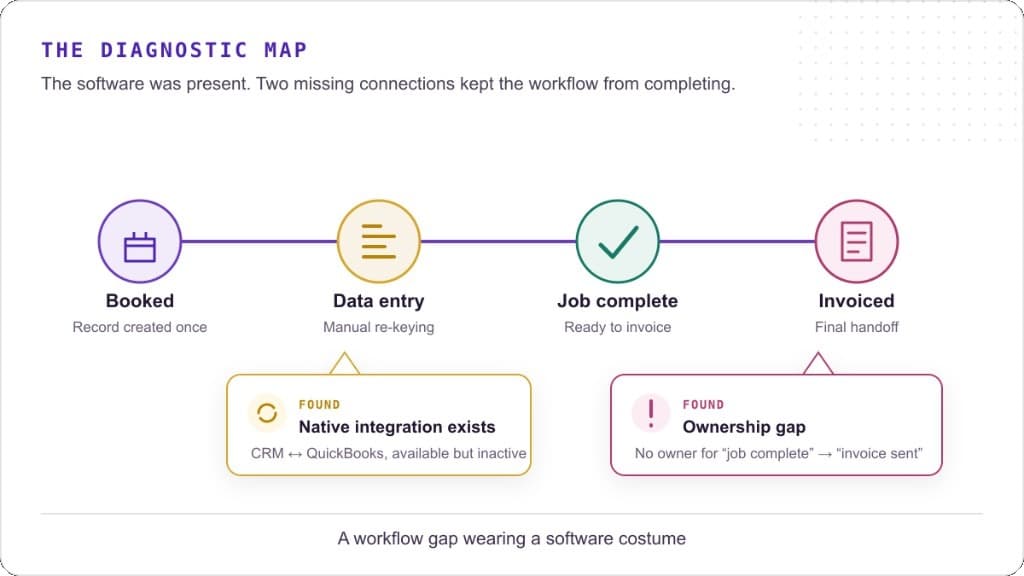
Imagine that a prospective client completes a form on the website. The form sends an email to an employee, who enters the contact into a CRM. A separate booking tool schedules the consultation. After the meeting, proposal details are stored in a document, payment information lives in an accounting application, and project status is tracked elsewhere.
Every tool may be functioning. The system can still be broken.
The issue may be that no platform holds a reliable end-to-end record of the customer relationship. It may be that status changes do not travel between systems. It may be that the workflow depends on one person remembering the next step. Replacing the website or adding an AI agent would not necessarily solve any of those problems.
Use the System Coherence Diagnostic
Once the workflow is visible, diagnose the system through five connected questions.
System Coherence Diagnostic
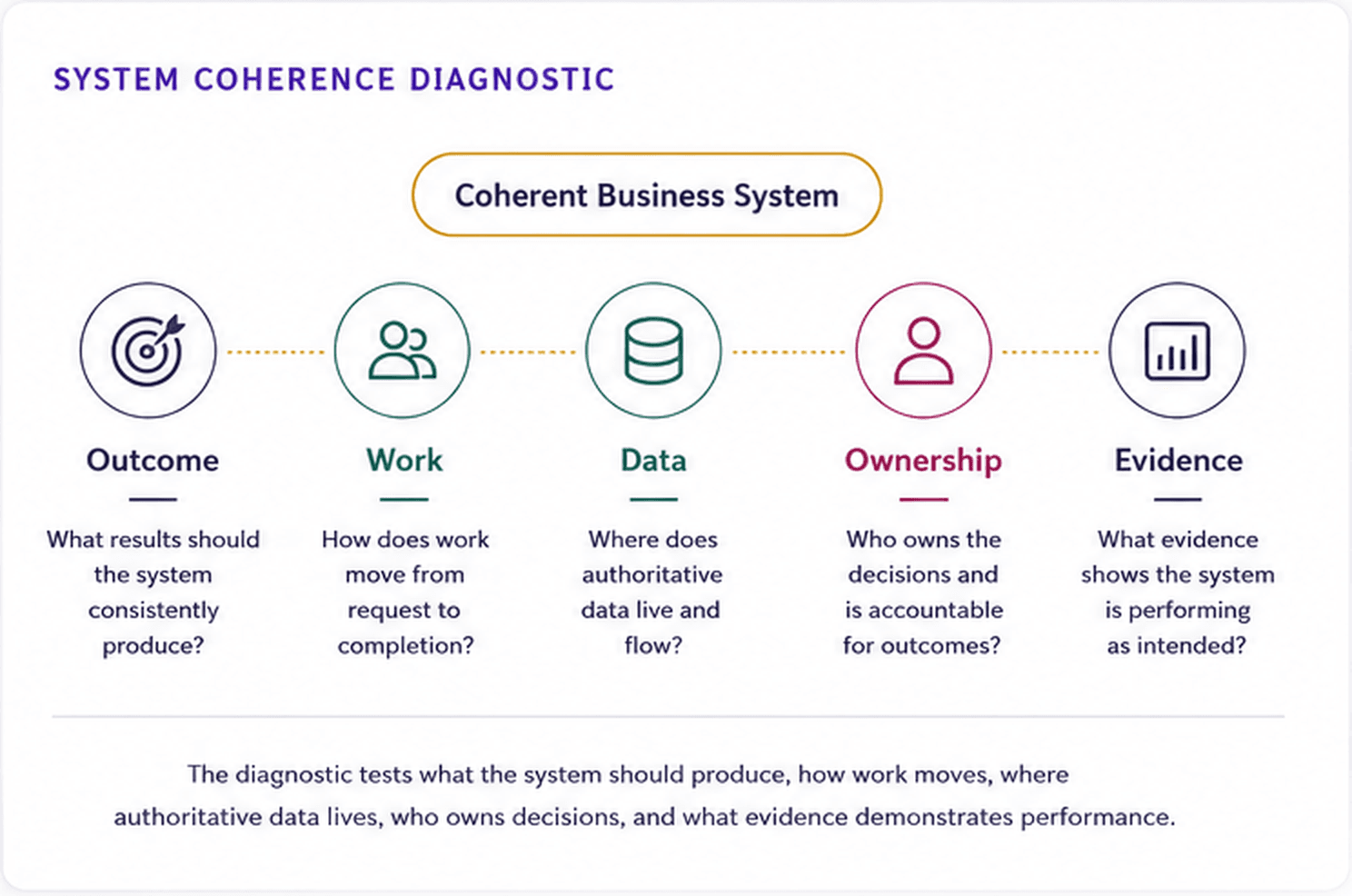
| Diagnostic question | What you are looking for | Warning sign |
|---|---|---|
| What outcome should the system produce? | A clear operational or customer result | Success is defined as installing or using the tool |
| How does work move from beginning to end? | A traceable workflow, including exceptions | Progress depends on inboxes, memory, or repeated follow-up |
| Where does essential data originate and remain authoritative? | A defined source of truth for each critical data type | The same information is re-entered, duplicated, or disputed |
| Who owns the process, the platform, and the decision? | Clear responsibility and decision rights | Vendors or individual employees become the only people who understand the system |
| What evidence shows the system is working? | Measures tied to time, quality, cost, conversion, or experience | Reporting shows activity but not business performance |
Diagnostic question
What outcome should the system produce?
What you are looking for
A clear operational or customer result
Warning sign
Success is defined as installing or using the tool
Diagnostic question
How does work move from beginning to end?
What you are looking for
A traceable workflow, including exceptions
Warning sign
Progress depends on inboxes, memory, or repeated follow-up
Diagnostic question
Where does essential data originate and remain authoritative?
What you are looking for
A defined source of truth for each critical data type
Warning sign
The same information is re-entered, duplicated, or disputed
Diagnostic question
Who owns the process, the platform, and the decision?
What you are looking for
Clear responsibility and decision rights
Warning sign
Vendors or individual employees become the only people who understand the system
Diagnostic question
What evidence shows the system is working?
What you are looking for
Measures tied to time, quality, cost, conversion, or experience
Warning sign
Reporting shows activity but not business performance
These questions are not separate checkpoints. They reveal the relationship between the business model and the technology environment.
For example, unclear ownership can create poor data quality because no one is accountable for defining how information should be maintained. Poor data quality can undermine automation. Failed automation can produce manual workarounds. Those workarounds then make reporting unreliable. What appears to be five technology problems is one connected operating problem.
Research on small and midsize businesses reflects this tension. In Salesforce’s sixth Small and Medium Business Trends research, 53% of SMB leaders reported inconsistencies in data across their tools, while 66% of leaders at growing SMBs said they relied on an integrated technology stack to keep operations running smoothly. The figures come from a technology vendor and should be read in that context, but the underlying distinction is useful: owning tools is not the same as connecting information and operations. (Salesforce, 2025 (opens in a new tab))
The diagnosis should lead to one of five decisions
A sound assessment does not assume that every business should consolidate onto one platform. An all-in-one system can reduce fragmentation, but it can also force the business into weak functionality, costly customization, or dependence on a single vendor. Specialized tools can work well when their roles, data boundaries, and handoffs are intentional.
The diagnosis should lead to a more precise decision:
Five technology decisions
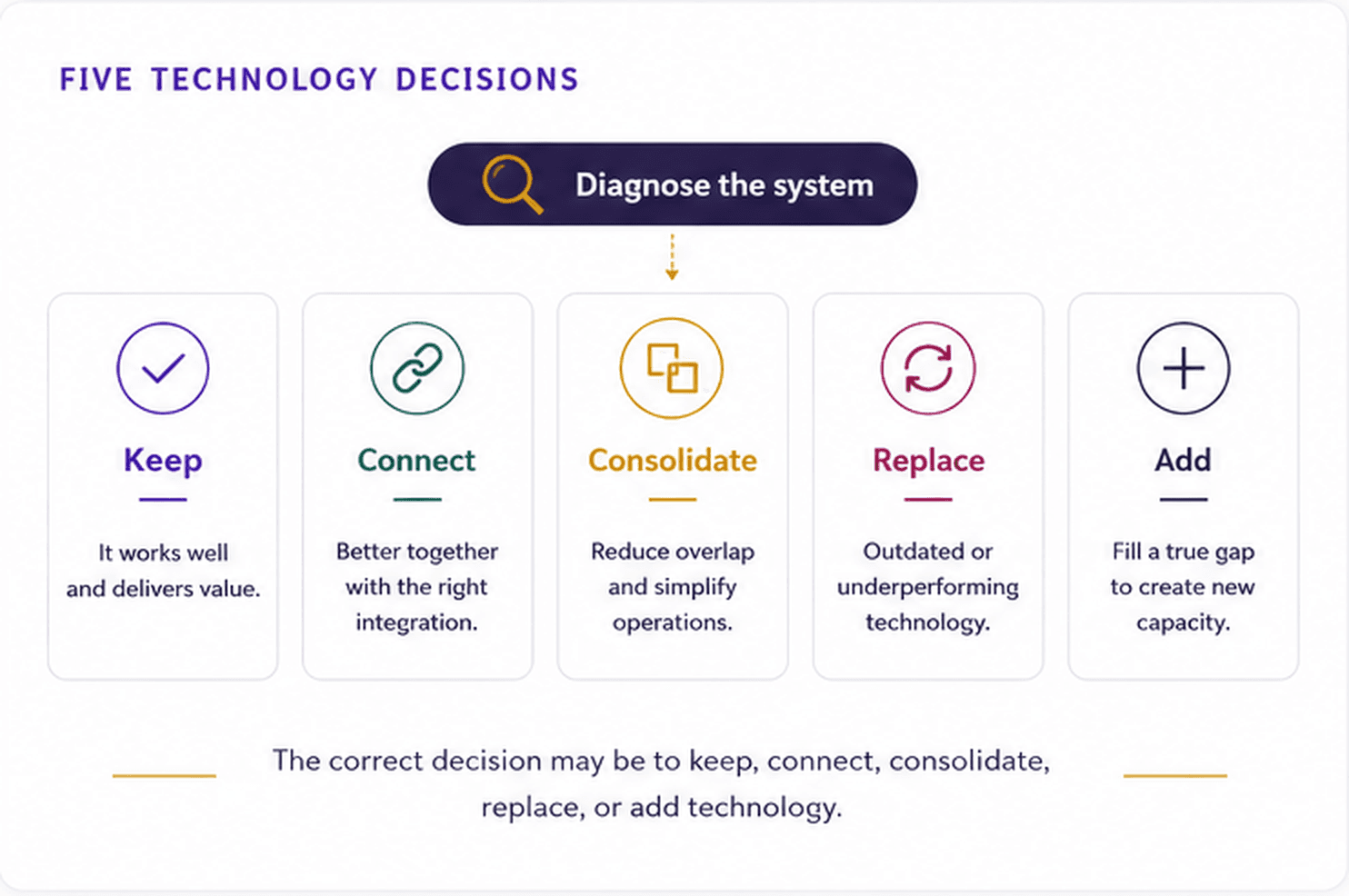
- Keep.
- The current tool performs a necessary role and fits the larger system. The issue may be adoption, configuration, or process discipline rather than capability.
- Connect.
- The tools are appropriate, but information or status must move between them more reliably. The answer may be integration, shared data definitions, or better orchestration.
- Consolidate.
- Multiple tools perform substantially the same function, creating unnecessary cost, confusion, or conflicting records.
- Replace.
- A platform cannot meet an important requirement, creates disproportionate risk or manual work, or no longer fits the business’s operating model.
- Add.
- A real capability is missing, and a new tool can fill that gap without creating more fragmentation than value.
The product is not the starting point. The business system is.
This is a different way to make technology decisions. The product is not the starting point. The business system is.
When another platform is the right answer
Sometimes the business truly does need new technology. The distinction is that the need should be demonstrated, not assumed.
A new platform is easier to justify when:
- a specific business capability is missing;
- the current environment cannot meet a defined requirement without unreasonable cost or risk;
- the new tool has a clear role and does not unnecessarily duplicate another system;
- the required integrations, data ownership, security, and operational support have been considered;
- the business can define how success will be measured after implementation.
If those conditions are not clear, product selection is premature. A feature comparison may help the business choose software while leaving it uncertain about what the software is supposed to solve.
Coherence is the real scaling capability
Growth exposes whatever the business has been holding together manually.
When volume is low, an experienced employee can bridge gaps between tools, remember exceptions, and reconcile conflicting information. As transactions, customers, employees, and services increase, that invisible coordination becomes harder to sustain. The business does not simply need more automation. It needs clearer rules, stronger connections, and an operating model that technology can support.
That is the deeper purpose of technology strategy for a growing business.
It is not to build the largest technology stack. It is to create enough coherence that the business can move, decide, serve, and grow without adding unnecessary friction at every stage.
Before you add another platform, trace one important workflow from beginning to end. Find where information stops, where ownership becomes unclear, where people compensate for the system, and where the reported activity separates from the business outcome.
Then decide what the system needs.
The answer may be another platform. But it may be a clearer architecture for the technology you already have.